

India has taken one of the most consequential steps in the evolution of its indigenous defence-industrial ecosystem by opening Defence Research and Development Organisation-developed conventional missile technologies to qualified domestic industry.
Defence Minister Rajnath Singh approved the transfer of DRDO-developed technologies relating to conventional missile systems to Indian companies for domestic production. The policy potentially enables qualified private companies to move beyond manufacturing components and subsystems and assume much larger responsibilities, including missile production, systems integration and, eventually, development of improved variants.
The distinction between conventional and strategic missiles is important. The policy concerns conventional missile systems rather than India’s nuclear-capable strategic missile arsenal; systems such as the Agni strategic missile family are outside the reported scope.
This is therefore not simply another defence procurement reform.
It represents a potential restructuring of India’s missile industrial base from a predominantly government-developed, public-sector-led production model into a broader government–private industrial partnership.
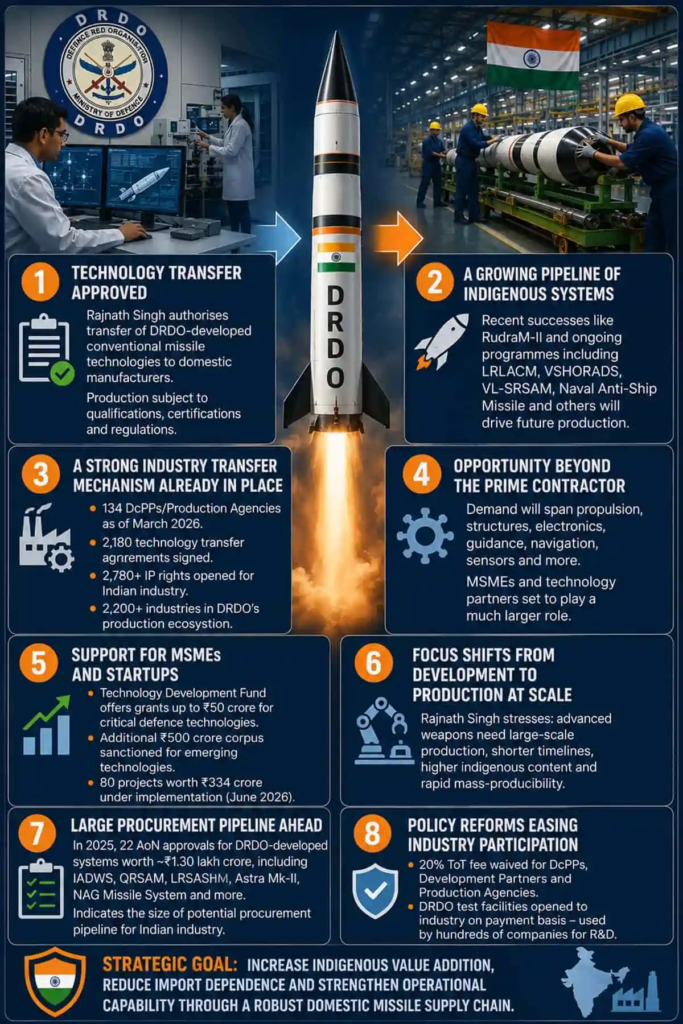
If implemented effectively, the reform could have consequences across India’s entire defence manufacturing ecosystem—from large companies such as Tata, Larsen & Toubro, Bharat Forge, Adani Defence and other major defence manufacturers to hundreds of MSMEs, electronics companies, software firms, materials specialists, precision-engineering companies and defence start-ups.
More importantly, it could gradually change the philosophy of Indian defence manufacturing from:
“DRDO develops and public-sector companies manufacture”
to:
“DRDO develops core technologies while multiple Indian industrial partners manufacture, integrate, improve and eventually develop next-generation systems.”
That transition could be transformational.
Why India Is Changing Its Missile Manufacturing Model
Modern warfare has demonstrated that possessing advanced weapons is not enough. Countries also require the industrial capacity to manufacture sophisticated weapons rapidly and replenish inventories during prolonged conflicts.
Missiles, air-defence interceptors, precision-guided weapons and loitering munitions can be consumed at enormous rates during high-intensity warfare.
A country may possess several hundred missiles when a conflict begins, but the strategic question quickly becomes:
How fast can those missiles be replaced?
This makes defence manufacturing capacity itself a strategic capability.
India’s traditional missile ecosystem has been centred around DRDO laboratories for research and development, while Defence Public Sector Undertakings—particularly Bharat Dynamics Limited and other government-controlled organisations—have played major roles in production and integration.
Private companies have participated extensively, but frequently as suppliers of structures, electronics, propulsion components, launchers, software, composites, subassemblies and engineering services.
The new approach can potentially move private industry much higher in the value chain.
Instead of merely supplying a missile component, an Indian company could ultimately become responsible for integrating and manufacturing an entire missile system under technology transferred by DRDO.
That distinction is extremely important.
From Component Manufacturers to Missile System Integrators
The biggest structural impact could be the creation of multiple Indian missile system integrators.
Missile manufacturing is far more complicated than assembling a few components.
A modern missile incorporates technologies involving:
- propulsion systems,
- seekers,
- navigation and guidance,
- flight-control systems,
- RF and electronic systems,
- communication and data links,
- radomes,
- advanced materials,
- composites,
- actuators,
- warheads,
- fuzes,
- embedded computing,
- software,
- launch systems,
- command-and-control integration,
- environmental qualification,
- testing and certification.
DRDO’s own July 2026 Expression of Interest concerning technology transfer for the Astra Mk-I weapon system illustrates the industrial sophistication required. Among other capabilities, prospective industry partners require facilities and expertise relating to missile-system assembly, electronics testing, environmental testing, quality assurance, trained technical personnel and relevant regulatory or industrial licences.
Therefore, transferring missile technology does something more important than generating additional missile factories.
It creates organisations capable of managing extremely complicated multidisciplinary defence programmes.
Once Indian private companies acquire that capability, the knowledge can potentially migrate into other areas such as air-defence systems, guided weapons, unmanned systems, counter-drone systems, aerospace manufacturing, space systems and advanced electronics.
1. India Could Create a Much Larger Missile Production Capacity
The first major benefit is straightforward: production scalability.
India’s armed forces require increasingly large inventories of:
- surface-to-air missiles,
- air-to-air missiles,
- anti-ship missiles,
- anti-tank guided weapons,
- precision-strike weapons,
- battlefield missiles,
- air-defence interceptors.
A limited number of production agencies inevitably creates capacity constraints.
Opening production to additional qualified Indian companies could create parallel manufacturing capacity.
Consider a simplified example.
Suppose one production ecosystem can manufacture 300 missiles annually.
If demand suddenly rises to 900 missiles annually, increasing production threefold may require significant new factories, tooling, workers and supply-chain capacity.
But if several qualified production partners already exist, production could potentially be distributed across multiple facilities.
India would therefore be developing not merely a missile inventory but a missile mobilisation capacity.
That capability becomes extremely important during prolonged military confrontation.
2. Competition Could Reduce Costs and Improve Manufacturing Efficiency
Another major change could come from competition.
Historically, sections of India’s defence manufacturing ecosystem operated through nomination-based production arrangements in which public-sector organisations were natural production agencies for systems developed by government laboratories.
The emerging model introduces the possibility of competitive selection of industrial partners. Reporting around the latest decision indicates competitive bidding could be used to select qualified Indian private companies for technology transfer and development-cum-production roles.
Competition could create pressure on manufacturers to improve:
Cost
Companies will need to control manufacturing expenses.
Delivery
Manufacturers that consistently meet production schedules could gain an advantage.
Quality
Defence systems require exceptionally rigorous quality assurance, and competition can reward organisations that demonstrate superior manufacturing reliability.
Automation
Private manufacturers may invest aggressively in robotics, digital manufacturing, advanced machining and automated testing.
Supply-chain management
Companies will have incentives to develop efficient networks of Indian suppliers.
The long-term result could be a defence manufacturing environment in which contracts are increasingly awarded according to capability, quality, price and delivery performance rather than institutional ownership alone.
3. DPSUs Could Face Serious Competition—but Also Become Stronger
The reform should not necessarily be viewed as an attack on India’s Defence Public Sector Undertakings.
Organisations such as Bharat Dynamics Limited have accumulated decades of specialised missile-production experience.
For example, India’s Akash surface-to-air missile system was developed by DRDO and subsequently produced and delivered through an industrial ecosystem involving major public-sector companies including BDL and BEL.
The new environment, however, could mean that DPSUs increasingly operate alongside private-sector competitors.
That could produce three important effects.
First, public-sector companies may become more focused on productivity, delivery schedules and manufacturing efficiency.
Second, DPSUs could increasingly become partners rather than sole production agencies, collaborating with private companies and MSMEs.
Third, Indian defence manufacturing could eventually develop multiple competing industrial groups specialising in different missile categories.
The ideal outcome is therefore not:
Private Sector vs DPSUs
but rather:
DRDO + DPSUs + Private Prime Contractors + MSMEs + Start-ups + Academia
working within one integrated national defence-industrial ecosystem.
4. The Biggest Winners Could Eventually Be Indian MSMEs
Large companies will attract most of the attention, but one of the most significant long-term beneficiaries could be India’s MSME sector.
A missile prime contractor does not manufacture every component internally.
It relies on specialised suppliers.
One missile programme can therefore generate business opportunities across companies producing:
- precision-machined components,
- electronic assemblies,
- PCBs,
- cables and connectors,
- specialised batteries,
- composites,
- castings and forgings,
- actuators,
- sensors,
- RF components,
- embedded computers,
- telemetry systems,
- test equipment,
- ground-support equipment,
- specialised coatings,
- software.
When multiple Indian companies become missile manufacturers, each begins building supplier networks.
Those suppliers subsequently develop intellectual property, manufacturing knowledge and specialised equipment.
The effect can spread through several layers of the economy:
DRDO → Prime Contractor → Tier-1 Suppliers → Tier-2 Suppliers → MSMEs → Start-ups
This industrial multiplier may ultimately be more economically important than the value of the missile contract itself.
The Ministry of Defence has explicitly identified creating opportunities for MSMEs and other technology partners in the domestic supply chain as an objective of expanding industry participation.
5. India’s Private Defence R&D Could Accelerate
Technology transfer should ideally not end with companies reproducing an existing DRDO design.
The larger objective should be creating private companies capable of absorbing the technology and improving it.
That could gradually create a cycle:
Technology Transfer
↓
Production
↓
Technology Absorption
↓
Incremental Improvement
↓
Private R&D
↓
New Missile Variants
↓
Independent Indigenous Technologies
This is where the reform could have its greatest strategic impact.
Once companies understand propulsion, guidance, aerodynamics, systems engineering, electronics and missile integration at production level, they can begin investing in their own R&D.
India could eventually develop several centres of missile innovation rather than depending overwhelmingly on government laboratories.
6. India’s Defence Start-up Ecosystem Could Receive a Major Boost
Missile programmes increasingly depend on technologies that are also being developed by civilian technology companies.
These include:
- artificial intelligence,
- computer vision,
- navigation,
- semiconductor technologies,
- autonomous systems,
- secure communications,
- advanced sensors,
- electronic warfare,
- simulation,
- digital twins,
- advanced materials.
A private missile manufacturer may be more willing and institutionally able to integrate specialised technologies from Indian start-ups into its products.
That could create an innovation chain such as:
DRDO missile architecture + private-sector systems integrator + Indian start-up technology
For example, a start-up might specialise in an RF seeker subsystem, navigation technology, image-processing software, simulation tools or advanced materials.
Instead of trying to become a complete missile manufacturer, it could supply highly specialised intellectual property to a large Indian defence prime.
India has already begun opening a larger portion of defence R&D to industry, start-ups and academia. Government data says 25% of the defence R&D budget has been opened to these groups since 2022–23, while access to specialised testing facilities across DRDO laboratories has also been expanded.
Missile technology transfer can reinforce that strategy.
7. India Could Develop a US-Style Defence Prime Contractor Ecosystem
The world’s largest defence manufacturing ecosystems generally depend on powerful private-sector prime contractors.
The United States has companies capable of independently managing enormous weapons programmes.
European defence manufacturing similarly includes major private or multinational industrial groups.
India’s structure has historically been different.
DRDO developed much of the technology while DPSUs and ordnance establishments handled significant portions of production.
India is unlikely simply to copy the American model.
But over time, the new policy could help create Indian equivalents of large defence prime contractors capable of:
- managing complete weapon programmes,
- integrating thousands of components,
- managing suppliers,
- conducting testing,
- maintaining configuration control,
- developing upgrades,
- supporting exports,
- maintaining weapons through their operational lifecycle.
That capability is strategically more important than merely owning factories.
8. Missile Exports Could Become a Major Indian Industry
India’s defence exports have already expanded dramatically.
Government figures show defence exports reached a record ₹38,424 crore in FY2025-26, up 62.66% from ₹23,622 crore the previous year. Private-sector companies accounted for approximately 45.16% of FY2025-26 defence exports.
The government has set a target of ₹50,000 crore in annual defence exports by 2029.
Missiles could become one of the most valuable categories supporting that ambition.
Missile exports have characteristics that make them economically attractive.
Customers purchase not merely missiles but frequently:
- launchers,
- radars,
- command systems,
- maintenance equipment,
- training,
- spare parts,
- simulators,
- software upgrades,
- technical support,
- replenishment missiles.
A successful missile export can therefore create a relationship lasting decades.
If several Indian companies become qualified missile manufacturers, India’s ability to simultaneously satisfy domestic requirements and foreign orders could increase considerably.
9. Defence Exports Could Create Economies of Scale
Exports are not merely a source of foreign exchange.
They can reduce the effective manufacturing cost of weapons purchased by India’s own armed forces.
Imagine that development and industrialisation costs are distributed over 500 missiles.
The per-unit cost could remain relatively high.
If export orders increase cumulative production to 2,000 missiles, fixed costs are spread across a much larger production run.
Suppliers also receive larger orders and can invest in automation.
This produces:
Higher Production
↓
Lower Unit Cost
↓
More Competitive Exports
↓
More Orders
↓
Greater Production Scale
↓
Further Cost Reduction
This virtuous cycle is one reason successful global defence companies aggressively pursue export markets.
10. India’s Defence Production Targets Become More Achievable
The missile technology decision is taking place while India’s overall defence manufacturing sector is already expanding rapidly.
India recorded defence production of approximately ₹1.78 lakh crore in FY2025-26, representing growth of 15.6% over the previous year and more than doubling from FY2020-21 levels.
The private sector accounted for approximately 24% of total defence production, or around ₹42,000 crore, its highest share so far.
The government is targeting annual defence production of ₹3 lakh crore by 2029.
Missile manufacturing could help increase the private sector’s share because missile systems are high-value products with large requirements for sophisticated electronics, propulsion, engineering and lifecycle support.
11. Supply-Chain Security Could Improve
One of the most important lessons from recent conflicts is that military supply chains become targets during wartime.
Foreign suppliers may face:
- export restrictions,
- political pressure,
- sanctions,
- transportation disruptions,
- semiconductor shortages,
- raw-material shortages,
- competing military demand.
Consequently, a weapon cannot be considered truly indigenous simply because final assembly occurs in India.
India needs domestic capability across critical technologies and materials.
The missile technology-transfer programme could encourage Indian companies to identify imported components and progressively replace them.
This creates another strategic cycle:
Domestic Missile Production
↓
Identification of Imported Components
↓
Indian Supplier Development
↓
Local Substitution
↓
Greater Indigenous Content
↓
Higher Wartime Supply Security
This is the difference between assembly independence and genuine technology sovereignty.
12. Private Capital Could Enter Strategic Manufacturing
Government organisations ultimately depend upon public budgets for expansion.
Private companies can mobilise additional capital from:
- corporate balance sheets,
- investors,
- capital markets,
- joint ventures,
- retained earnings.
Once companies see predictable missile orders extending over many years, they can justify investments in specialised manufacturing facilities.
This could result in new:
- propulsion plants,
- composite facilities,
- electronics production lines,
- seeker manufacturing facilities,
- environmental-test laboratories,
- precision-machining centres,
- integration facilities.
Thus government technology can potentially unlock private investment in national strategic manufacturing capacity.
13. Skilled Employment Could Expand Significantly
Missile manufacturing is engineering intensive.
Expanding production across private industry would increase demand for:
- aerospace engineers,
- mechanical engineers,
- electronics engineers,
- RF engineers,
- materials scientists,
- software engineers,
- AI specialists,
- manufacturing engineers,
- quality specialists,
- systems engineers,
- technicians.
Perhaps even more importantly, India would develop engineers with experience in complete weapon-system lifecycle management.
That expertise cannot be created simply through university education.
It comes from repeatedly designing, manufacturing, testing, troubleshooting and upgrading real systems.
14. DRDO’s Role Could Gradually Change
An equally important consequence concerns DRDO itself.
If mature technologies can be transferred more systematically to industry, DRDO laboratories can potentially concentrate more resources on next-generation research.
Instead of remaining deeply involved in production-related activities for mature systems, laboratories could devote greater attention to:
- next-generation propulsion,
- advanced seekers,
- hypersonic technologies,
- directed-energy technologies,
- advanced guidance,
- electronic warfare,
- autonomous systems,
- counter-hypersonic technologies,
- new materials,
- advanced air defence.
A mature defence ecosystem should ideally divide responsibilities according to comparative advantage.
DRDO: High-risk research and advanced technology.
Industry: Industrialisation, manufacturing and lifecycle support.
Start-ups: Disruptive specialised technologies.
Academia: Fundamental research.
Armed Forces: Operational requirements, testing and feedback.
That would represent a much more sophisticated national innovation system.
15. Development Cycles Could Become Shorter
Another potential advantage is speed.
Traditional defence development can take years because of sequential processes involving development, testing, industrialisation, procurement and production.
Early involvement of production partners can create a more concurrent process:
Armed Forces Requirement
↓
DRDO + Industry Development
↓
Prototype
↓
Testing
↓
Manufacturing Engineering
↓
Production
If manufacturers participate during development rather than entering only after development has largely concluded, problems associated with manufacturability can be identified much earlier.
This can reduce the gap between a successful prototype and mass production.
16. India’s Strategic Autonomy Could Increase
The geopolitical consequence may ultimately be larger than the industrial consequence.
Countries dependent on imported weapons remain vulnerable to their suppliers.
During a crisis, foreign governments can potentially influence:
- spare-part availability,
- ammunition supply,
- upgrades,
- maintenance,
- software support,
- export clearances.
Domestic missile production reduces some of these vulnerabilities.
But the greater strategic advantage comes from controlling the ability to modify the weapon.
If India controls the underlying technology, it can potentially adapt systems to changing threats without waiting for approval from a foreign original equipment manufacturer.
That improves strategic autonomy.
The Challenges Should Not Be Underestimated
Despite the enormous potential, transferring missile technology will not automatically create a world-class defence industry.
Several difficult problems must be addressed.
Protecting Sensitive Technology
Missile technologies have obvious national-security implications.
Companies receiving them will require extremely strong controls covering:
- cybersecurity,
- physical security,
- employee access,
- classified information,
- subcontractors,
- foreign investment,
- intellectual property.
The larger the industrial ecosystem becomes, the larger the potential attack surface for espionage.
Technology security therefore needs to expand at exactly the same pace as technology transfer.
Quality Control Cannot Be Compromised
Missiles cannot be treated like ordinary manufactured products.
Extremely small manufacturing deviations can result in catastrophic failure.
Private companies entering missile manufacturing will therefore require rigorous certification and quality-assurance systems.
The armed forces and DRDO must ensure that competition does not produce pressure to compromise reliability for cost reduction.
In defence manufacturing:
the cheapest missile is irrelevant if it fails when launched.
Quality, reliability and repeatability must remain paramount.
Intellectual Property Rules Must Be Clear
Another critical question concerns ownership of future improvements.
Suppose DRDO transfers Missile Technology A to Company X.
Company X invests heavily and develops Technology A+.
Who owns the improvements?
Can Company X export A+?
Can DRDO transfer those improvements to another manufacturer?
Can another Indian company manufacture the improved design?
These issues require clear contractual frameworks.
Without clarity, private companies may hesitate to invest heavily in R&D.
Companies Need Predictable Orders
Technology transfer alone will not create manufacturing capacity.
Industry needs visibility into future demand.
A company will not invest thousands of crores in specialised missile facilities if it expects only a small production order.
India therefore needs a combination of:
Technology Transfer + Long-Term Procurement Visibility + Export Opportunities
Only then can companies confidently invest in capacity.
Too Many Manufacturers Could Also Become Inefficient
Competition is beneficial, but excessive fragmentation can be counterproductive.
Missile manufacturing requires expensive specialised infrastructure.
If five companies invest in identical production facilities but each receives only a small number of orders, the ecosystem may become economically inefficient.
India therefore needs a carefully designed industrial strategy balancing:
competition with economies of scale.
In some programmes, two qualified production partners may be preferable to five or six.
The Real Transformation: From Make in India to Design in India
The ultimate test of this reform will not be how many DRDO missiles private companies manufacture.
The real test will come perhaps a decade later.
Will Indian private companies still simply manufacture DRDO-designed missiles?
Or will they begin developing their own?
That is the difference between:
Make in India
and
Design, Develop and Make in India.
A mature Indian defence ecosystem should eventually have multiple organisations independently developing missiles, sensors, radars, propulsion technologies and autonomous weapons while DRDO focuses on strategic and high-risk technologies.
What India’s Defence Ecosystem Could Look Like by the 2030s
If this reform is implemented consistently, India’s defence-industrial structure could evolve substantially.
Layer 1 — Government Research
DRDO develops frontier technologies.
Layer 2 — Large Indian Defence Primes
Private companies and DPSUs compete and collaborate as complete system integrators.
Layer 3 — Specialised Technology Companies
Companies develop seekers, propulsion systems, sensors, radars, electronics and advanced materials.
Layer 4 — MSMEs
Thousands of smaller manufacturers provide precision components and subassemblies.
Layer 5 — Defence Start-ups
Start-ups introduce AI, autonomy, robotics, software and disruptive technologies.
Layer 6 — Universities
Academic institutions support fundamental research.
Layer 7 — Global Customers
Exports provide production scale and finance continued R&D.
That is how a sustainable defence-industrial ecosystem develops.
A Potential Industrial Multiplier
The significance of missile technology transfer should therefore not be measured only by the number of missiles manufactured.
Consider the wider chain:
DRDO Technology
↓
Private Missile Manufacturer
↓
New Manufacturing Facility
↓
Indian Supplier Network
↓
MSME Expansion
↓
Engineering Employment
↓
Private R&D
↓
New Indigenous Technology
↓
Exports
↓
Higher Production Volumes
↓
Lower Costs
↓
Greater Indian Military Preparedness
↓
More R&D Investment
If that cycle develops successfully, missile technology transfer could become an industrial multiplier for India’s broader aerospace and defence sector.
India Is Building an Industrial Deterrent
Military deterrence is normally discussed in terms of fighter aircraft, warships, missiles and soldiers.
But modern warfare has introduced another concept:
Industrial Deterrence
An adversary must calculate not merely how many missiles India possesses today but how rapidly India could manufacture thousands more during a prolonged confrontation.
A country with 1,000 missiles and limited production capacity may eventually become vulnerable.
A country with 1,000 missiles but an industrial network capable of rapidly replenishing them presents a very different strategic challenge.
By spreading missile-manufacturing knowledge across a larger domestic industrial ecosystem, India can potentially create this second form of deterrence.
Conclusion
India’s decision to transfer DRDO-developed conventional missile technologies to qualified domestic industry could eventually be remembered as an important turning point in the evolution of the country’s defence-industrial base.
For decades, India’s defence model depended heavily on government laboratories for technology, public-sector companies for production and foreign suppliers for many sophisticated platforms and components.
That structure is gradually changing.
India’s defence production has already reached a record ₹1.78 lakh crore in FY2025-26, while exports have reached ₹38,424 crore. The private sector now represents about 24% of domestic defence production and more than 45% of defence exports.
Missile technology transfer could accelerate the next stage of that transformation.
Its greatest contribution may not simply be that private companies manufacture more missiles.
The deeper impact would be the creation of:
multiple Indian system integrators,
a deeper indigenous supply chain,
thousands of specialised MSME suppliers,
greater private-sector R&D,
larger wartime production capacity,
stronger defence exports,
and eventually,
Indian companies capable of independently designing the next generation of sophisticated weapons.
The transition will require strict technology protection, rigorous quality control, predictable procurement, clear intellectual-property rules and sustained competition. But if those conditions are created, India’s defence manufacturing model could fundamentally change during the next decade.
The country would move progressively from being an importer of sophisticated military technology to being a producer, then an exporter—and ultimately an originator of advanced defence technologies.
That is the larger significance of opening missile technology to Indian private industry.
It is not simply about manufacturing missiles.
It is about creating the industrial capacity, technological depth and private-sector innovation ecosystem required for India to become a genuinely self-reliant global defence manufacturing power.
