

India is heading into a politically significant weekend. The Cockroach Janta Party (CJP), an emerging youth-led political movement headed by Abhijeet Dipke, has called for a major mobilisation at Delhi’s Jantar Mantar on October 10, 2026, principally demanding the resignation of Chief Election Commissioner Gyanesh Kumar and greater accountability over the Special Intensive Revision (SIR) of electoral rolls.
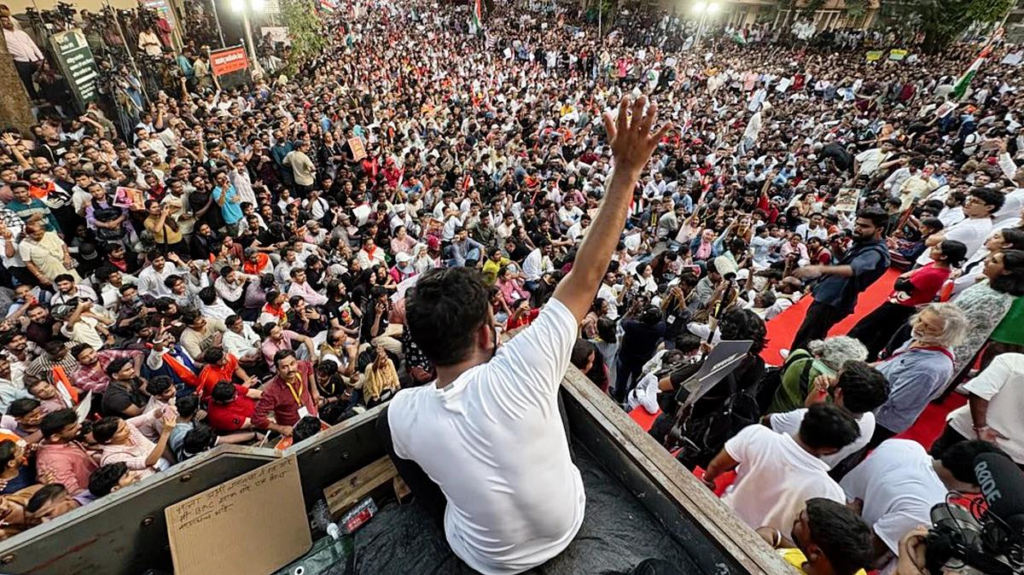
The proposed demonstration follows protests in Mumbai, Bengaluru and other cities and comes amid an increasingly contentious national debate over voter-list deletions.
It is important, however, to distinguish between three separate questions: the legitimacy of complaints about electoral rolls, the political significance of the CJP movement, and claims that India may be approaching a “regime change.” The first two are already subjects of documented political and institutional dispute. The third remains substantially more speculative.
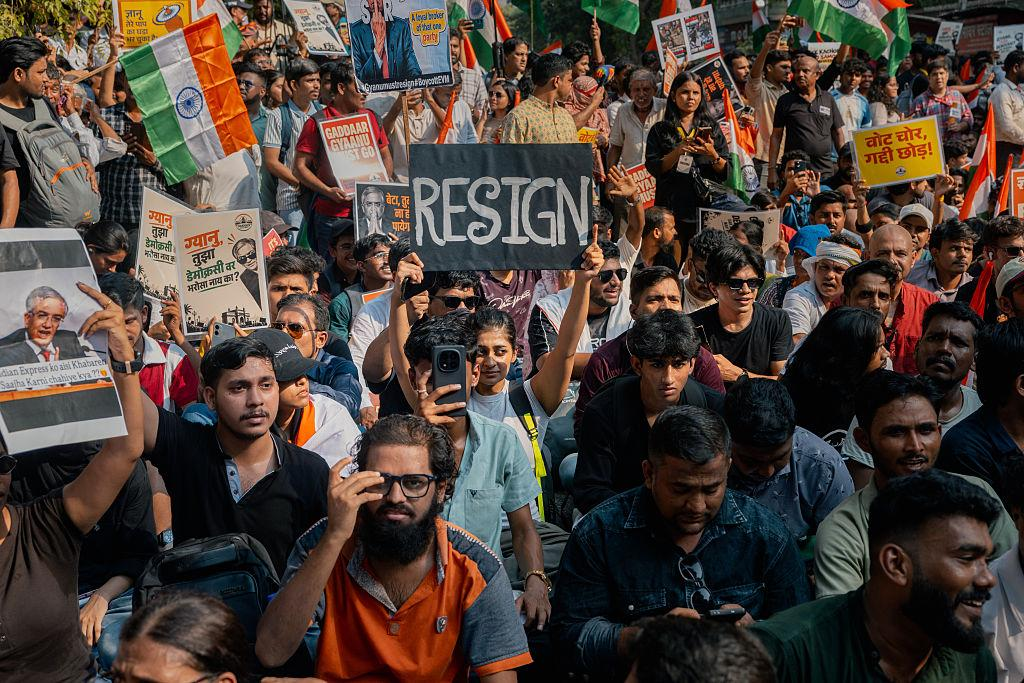
As of October 9, the October 10 demonstration has not yet taken place, so any assessment of its eventual size or political consequences must remain conditional.
Why is CJP protesting?
The immediate controversy revolves around the Election Commission’s nationwide Special Intensive Revision of electoral rolls.
More than 13 crore names have reportedly been excluded from draft electoral rolls during the SIR exercise across multiple states and Union Territories. The Election Commission disputes the characterization that these represent arbitrary or permanent disenfranchisement. It says many names fall into categories such as deceased voters, permanently shifted voters, duplicate registrations or people who were absent during verification, while eligible citizens have mechanisms to seek inclusion. Moneycontrol
Critics, opposition parties and activists have raised a different concern: whether the scale and methodology of the exercise could result in legitimate voters losing their franchise, particularly where documentation, address changes or verification problems are involved.
The controversy acquired additional institutional significance after The Indian Express reported that Election Commissioners Sukhbir Singh Sandhu and Vivek Joshi had recorded objections on multiple occasions concerning decisions and procedures associated with the revision exercise. The Indian Express
CJP has consequently turned what could have remained a technical controversy about electoral-roll management into a political question:
Who gets to vote, who decides whether a person remains on the electoral roll, and how transparent must that decision be?
That framing explains why the movement potentially reaches beyond CJP itself.
The October 10 confrontation
CJP has called supporters from around the country to Delhi and says it intends to proceed despite the authorities’ refusal to approve the Jantar Mantar gathering.
Delhi Police says CJP’s application arrived on October 7, whereas applications for Jantar Mantar demonstrations are expected substantially earlier. Police have also cited alleged non-compliance with conditions imposed during previous demonstrations, traffic concerns and public-order considerations. Section 163 of the Bharatiya Nagarik Suraksha Sanhita has been invoked in the New Delhi district.
The Ministry of Home Affairs has also warned states and Union Territories about what it describes as potentially serious law-and-order implications arising from the mobilisation. The Indian Express
Security preparations are unusually extensive. Reports describe checkpoints, designated detention facilities and measures intended to prevent large groups from reaching central Delhi. Some demonstrators travelling toward Delhi have already been intercepted by police outside the capital. The Indian Express
Transport is being affected as well, with train cancellations and rescheduling reported ahead of the demonstration. Hindustan Times
That creates a politically important situation: the story of October 10 may ultimately be determined as much by the state’s handling of the protest as by the number of protesters who reach Jantar Mantar.
Why CJP suddenly matters
CJP’s significance cannot be measured simply by asking how many MPs, MLAs or traditional party workers it controls.
It represents a different form of political mobilisation.
The movement combines social-media activism, student politics, anti-establishment rhetoric and street demonstrations. Its events have attracted activists, student organisations and public personalities. A Bengaluru demonstration on October 8, for example, included Abhijeet Dipke alongside figures including Prakash Raj and Dhruv Rathee. The Indian Express
The Mumbai mobilisation earlier this month demonstrated that the movement can also attract significant crowds outside Delhi. The Times of India
Three features are especially important.
1. It is attempting to mobilise younger citizens
Traditional Indian protest politics has generally depended upon party cadres, unions, farmers’ organisations, caste organisations or established civil-society networks.
CJP is trying to build mobilisation around something different: digitally connected younger voters whose political identity may not necessarily correspond to membership of an established political party.
That does not automatically translate into electoral power.
But it can change the language through which political dissatisfaction is expressed.
2. Its central issue is voting rights
Movements based around unemployment, corruption, examinations or inflation can be politically powerful.
A movement questioning the integrity of the electoral process itself potentially operates at another level because elections are the mechanism through which every other political dispute is ultimately resolved.
The Constitution gives the Election Commission responsibility for the “superintendence, direction and control” of electoral rolls and elections. Legislative Assembly of India
Therefore, accusations concerning voter registration go directly to public confidence in one of India’s core constitutional institutions.
That makes transparency particularly important irrespective of which party ultimately benefits or suffers politically.
3. It is not simply an extension of the conventional Opposition
This may prove politically important.
Congress reportedly shares some of the concerns surrounding the electoral-roll controversy but has kept some distance from the CJP-led October 10 mobilisation, while several other opposition parties and organisations have been more supportive. The Economic Times
That produces an unusual dynamic.
CJP could cooperate with opposition organisations on particular issues without becoming subordinate to them.
Alternatively, established parties could eventually absorb much of its political energy.
Which of these occurs will matter enormously for the movement’s long-term significance.
The first major impact: pressure on the Election Commission
Perhaps the greatest institutional consequence of the protests is not whether one official resigns.
It is the pressure being placed upon the Election Commission to demonstrate that the SIR process is:
- procedurally consistent,
- politically neutral,
- auditable,
- reversible when errors occur,
- and accessible to ordinary voters seeking restoration of their names.
The ECI maintains that it is an independent constitutional institution and that decisions of the three-member Commission are taken through its established processes. Election Commission of India
Political critics dispute aspects of the current process.
The strongest democratic resolution would therefore come not simply through competing political accusations, but through verifiable electoral data and transparent procedures.
Could Gyanesh Kumar simply be removed because of protests?
No.
This is one area where political rhetoric sometimes obscures constitutional reality.
The Chief Election Commissioner enjoys strong constitutional protection.
Article 324 provides that the CEC cannot be removed except in the same manner and on the same grounds as a judge of the Supreme Court. Legislative Assembly of India
Consequently, there are two very different possibilities.
A CEC could voluntarily resign.
But forcibly removing the CEC requires the constitutionally prescribed parliamentary process; a street demonstration by itself cannot remove the officeholder.
That distinction matters when assessing CJP’s immediate demands.
The second impact: a test of protest policing
October 10 is also becoming a test of India’s approach to political dissent.
Authorities have legitimate responsibilities to prevent violence, protect public infrastructure and maintain traffic and emergency services.
Citizens, meanwhile, possess constitutional protections involving freedom of speech and peaceful assembly, subject to legally permissible restrictions.
The difficult question is therefore not whether protests can ever be regulated. They clearly can.
The real question is one of proportionality.
If authorities prevent large numbers of people from travelling, close transport infrastructure or make preventive detentions, public debate will inevitably focus on whether those actions were necessary for public safety or excessively restrictive.
Conversely, if protesters breach barricades, damage property or engage in violence, the political narrative could shift rapidly toward law and order.
For CJP, therefore, maintaining peaceful discipline is strategically significant.
The third impact: CJP could become larger than its original organisation
Modern protest movements often develop according to a recognisable pattern.
They begin around one grievance.
That grievance produces demonstrations.
Government response becomes a second grievance.
The movement then broadens from its original demand into a larger argument about institutions, civil liberties or political accountability.
Something resembling that process may be developing here.
CJP began the current mobilisation around the Election Commission and electoral rolls.
But its rhetoric is increasingly encompassing broader questions concerning democracy, institutional accountability and protest rights.
That expansion can increase a movement’s appeal.
It also creates a danger for the organisers: the broader the coalition, the harder it becomes to maintain a coherent set of achievable demands.
What October 10 could mean for the Modi government
The demonstration itself does not constitutionally threaten the survival of the Union government.
This distinction is essential.
India has a parliamentary system. Article 75(3) states that the Council of Ministers is collectively responsible to the Lok Sabha. The constitutional principle is therefore that a government remains in office so long as it retains the confidence of the House. Legislative Assembly of India
A protest—even an enormous protest—does not replace that parliamentary mechanism.
However, demonstrations can create indirect political consequences.
They can change public debate.
They can pressure institutions.
They can persuade opposition parties to coordinate.
They can influence future elections.
They can also alter the calculations of coalition partners and MPs.
Those are the channels through which street politics can eventually interact with parliamentary politics.
So what would “regime change” actually mean in India?
The phrase should be used carefully.
In geopolitical language, “regime change” sometimes implies the removal of a government through extra-constitutional means.
There is currently no basis for treating that as the established trajectory of the October 10 movement.
In an Indian constitutional context, it is more useful to speak about government change.
There are several possible pathways.
Scenario 1 — Protest pressure produces institutional concessions
This is the least constitutionally disruptive scenario.
Sustained public pressure could produce greater transparency around the SIR exercise, accelerated restoration mechanisms for incorrectly removed voters, judicial scrutiny or changes in electoral procedures.
The government itself would remain intact.
In this scenario the movement’s impact would be institutional rather than governmental.
Scenario 2 — The CEC controversy is resolved without a change of government
Political pressure could become intense while remaining centred on the Election Commission.
That could theoretically involve voluntary resignation, parliamentary proceedings, court-driven procedural changes, or reforms to electoral administration.
Even a dramatic development involving the Election Commission would not automatically amount to a change of national government.
The two questions should therefore not be conflated.
Scenario 3 — CJP evolves into a sustained national political movement
October 10 could become a starting point rather than an endpoint.
For that to happen, CJP would need more than viral visibility.
It would require durable organisation across states, local leadership, funding, volunteers, internal governance and a political programme extending beyond protests.
India has repeatedly seen mass movements struggle with the transition from mobilisation to institution-building.
Demonstrating against something and building an organisation capable of governing are very different political tasks.
Whether CJP attempts that transition may eventually prove more consequential than the crowd size on October 10.
Scenario 4 — CJP becomes part of a broader opposition coalition
Another possibility is convergence between CJP, student organisations, civil-society activists and established opposition parties.
The current picture remains mixed: Congress has reportedly maintained some distance from the CJP-led agitation even while opposition parties share concerns about the Election Commission controversy. The Economic Times
If coordination becomes deeper, the electoral-roll issue could become one component of a broader anti-government political platform.
But cooperation also creates tensions.
A movement portraying itself as independent of the political establishment risks losing some of that identity if it becomes closely associated with conventional opposition parties.
Scenario 5 — Parliamentary instability
This is the genuine constitutional route through which protests could eventually intersect with a change of government before a scheduled general election.
For that to happen, street mobilisation would have to produce a completely separate political development inside Parliament: the government would need to lose the confidence of the Lok Sabha.
Article 75’s collective-responsibility requirement makes parliamentary majority—not street turnout—the decisive constitutional test. Legislative Assembly of India
Therefore:
Large protests ≠ fall of government.
For government change to occur through parliamentary means, the political arithmetic of the Lok Sabha itself must change.
That is a significantly higher threshold.
Scenario 6 — Electoral change at a future general election
The most conventional mechanism is also the most important.
If dissatisfaction surrounding electoral rolls, unemployment, institutional trust or other issues expands sufficiently, those concerns may influence voters in future elections.
The result would then be decided through the electoral process itself.
It would be inappropriate to predict which party would benefit from such a development; public opinion, alliances and political conditions can change substantially before an election.
But this is the principal democratic mechanism through which nationwide protest movements can eventually translate into governmental change.
Scenario 7 — An extra-constitutional “regime change”
This is the scenario that attracts the most sensational discussion online, but currently has the weakest factual foundation.
India possesses functioning constitutional institutions, Parliament, courts, state governments, elections and an established mechanism for political succession.
There is presently no credible evidence that the October 10 protest constitutes an organised attempt to overthrow India’s constitutional system.
A protest movement demanding resignations or electoral reforms—even when highly confrontational—is not by itself evidence of a coup or foreign-backed regime-change operation.
Claims of that nature would require substantial evidence involving financing, organisation, coordination or explicit extra-constitutional plans.
Without such evidence, they remain allegations rather than established facts.
The government’s dilemma
The authorities face a difficult political calculation.
A very permissive approach carries the risk that an unexpectedly large mobilisation grows further.
A very restrictive response carries the opposite risk: transforming CJP from the organiser of a protest into a symbol of resistance.
Political history repeatedly demonstrates this paradox.
Authorities may succeed operationally in preventing protesters from assembling while simultaneously increasing the protest’s political visibility.
That is why October 10 should not be evaluated solely through the question:
“How many people reached Jantar Mantar?”
Equally important will be:
“What happened to the people who tried?”
CJP’s own dilemma
The movement faces an equally important test.
Successful protest politics requires more than anger.
CJP will need to demonstrate that it can maintain peaceful mobilisation, articulate specific demands, verify allegations, avoid inflammatory rhetoric and prevent fringe groups from hijacking its demonstrations.
A movement centred on protecting democratic institutions strengthens its argument when its own methods remain demonstrably democratic and peaceful.
Any serious violence would alter that equation dramatically.
The role of the Supreme Court
Another variable is judicial scrutiny.
Questions concerning electoral-roll procedures increasingly have a legal as well as political dimension.
The judiciary can examine whether administrative actions conform to constitutional and statutory requirements, although courts do not ordinarily substitute themselves for election administrators in every operational matter.
This means the dispute could gradually move from streets and television debates into litigation concerning procedural fairness, voter restoration and the scope of the Election Commission’s authority.
Such an outcome would represent institutional contestation rather than regime change.
The biggest underlying issue: institutional trust
The most important long-term question may not ultimately be CJP, Gyanesh Kumar or even October 10.
It is trust.
Modern democracies depend upon losers accepting election results.
That acceptance requires citizens across political divisions to believe that:
their votes will be counted;
their names will not arbitrarily disappear;
electoral rules apply equally;
and institutions administering elections are politically impartial.
Once confidence in those assumptions weakens, every electoral outcome becomes harder to legitimise.
That is why both sides of the dispute carry substantial responsibilities.
Critics alleging disenfranchisement need evidence.
The Election Commission needs transparent data and accessible remedies.
Political parties should avoid presenting unverified allegations as established facts.
And authorities responsible for demonstrations need to distinguish legitimate security requirements from unnecessarily restrictive measures.
October 10 may be a turning point—but not necessarily a regime-change moment
The significance of the CJP mobilisation should neither be dismissed nor exaggerated.
The movement has succeeded in bringing an obscure but extraordinarily important administrative process—electoral-roll revision—into mainstream political debate.
It has demonstrated the ability to mobilise young citizens and attract significant media attention.
And the scale of preventive measures being taken by authorities indicates that the government considers the mobilisation a serious law-and-order event. The Indian Express
But jumping from those facts to predictions of imminent regime change would go considerably beyond the available evidence.
The more plausible question is whether India is witnessing the early stages of a new political mobilisation capable of influencing institutions, opposition politics and future electoral debate.
October 10 will provide some evidence.
It will show whether CJP can translate online momentum into nationwide physical mobilisation; whether its appeal extends beyond particular urban constituencies; whether opposition parties converge around it or keep their distance; whether authorities can manage a contentious protest proportionately; and whether the electoral-roll controversy produces concrete institutional reforms.
The most consequential outcome may therefore not occur on October 10 at all.
It may emerge during the months that follow—through electoral-roll corrections, court cases, parliamentary debate, coalition politics and, ultimately, the ballot box.
In India’s constitutional system, that distinction is fundamental: protests can reshape politics, but changing the national government requires parliamentary or electoral consequences.
