

A commercial dispute over satellite internet has rapidly turned into one of India’s most politically charged technology controversies.
Elon Musk, the billionaire entrepreneur behind SpaceX and its satellite broadband service Starlink, has launched unusually sharp public criticism of India’s regulatory process, questioned the influence of powerful Indian business interests and directly invoked Reliance Industries chairman Mukesh Ambani.
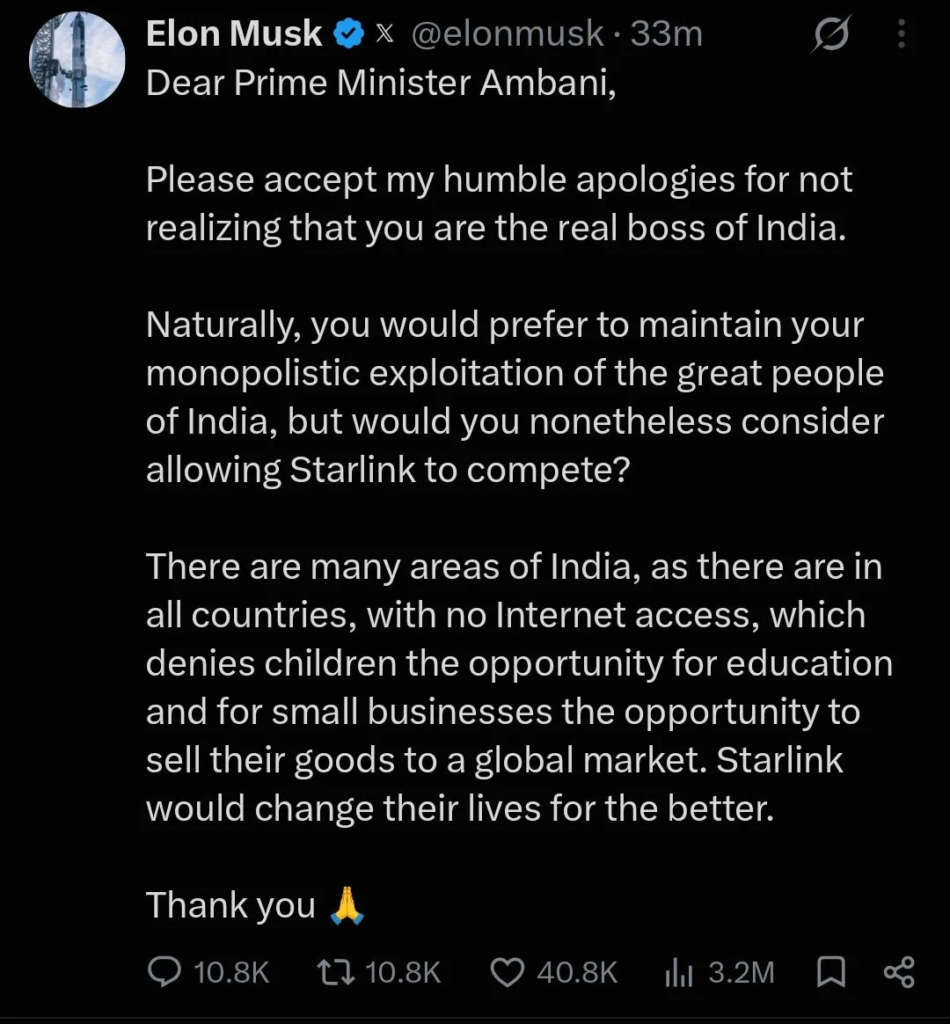
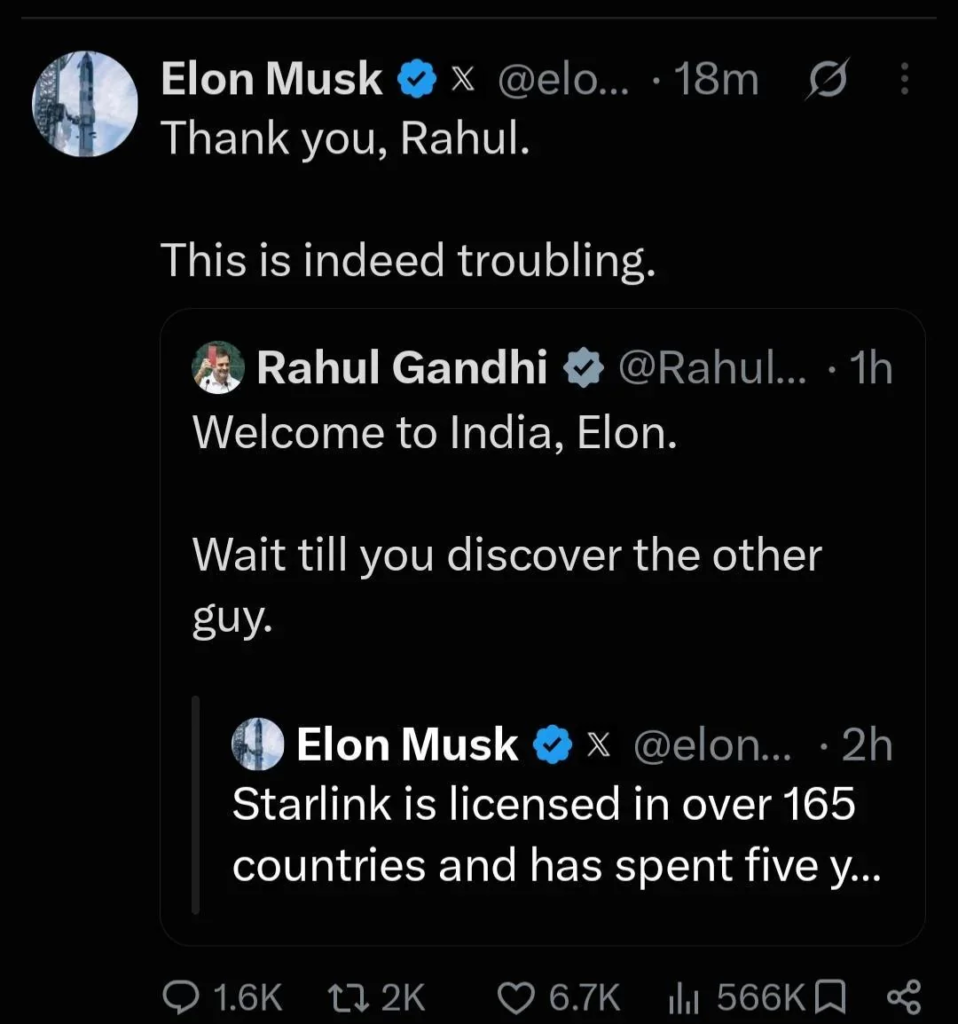
The controversy became even more politically significant when Leader of the Opposition Rahul Gandhi joined the exchange on X. Musk subsequently thanked Gandhi and described the situation he had raised as “troubling.”
What began as a regulatory disagreement over satellite communications has therefore expanded into a larger debate involving competition, corporate influence, national security, telecom regulation and political accusations.
How the controversy began
Starlink has been attempting to establish commercial satellite broadband operations in India for several years.
The company eventually secured a Global Mobile Personal Communication by Satellite, or GMPCS, authorisation from the Department of Telecommunications. Government records have listed Starlink alongside Jio Satellite Communications and OneWeb India as licensed GMPCS operators.
However, obtaining a telecom licence does not automatically mean that a satellite company can immediately start providing commercial services.
Satellite operators must also satisfy additional security conditions and obtain spectrum assignment before they can commercially launch.
That distinction became central to the controversy.
By October 2026, Musk had become openly frustrated with the length of the process. He claimed that Starlink had spent years complying with Indian requirements but was still unable to begin commercial service.
His criticism quickly moved beyond bureaucracy.
Musk alleged that “certain oligarchs” were attempting to prevent Starlink from entering the Indian market in order to protect their existing commercial positions. He did not initially identify the individuals he was referring to.
The allegation immediately transformed a regulatory dispute into a political and corporate controversy.
Musk brings Mukesh Ambani directly into the dispute
On October 8, Musk intensified his criticism.
He wrote that Starlink was licensed in more than 165 countries and claimed the company had spent five years complying with Indian laws and government requirements.
He then publicly asked:
“Is Ambani the real boss of India?”
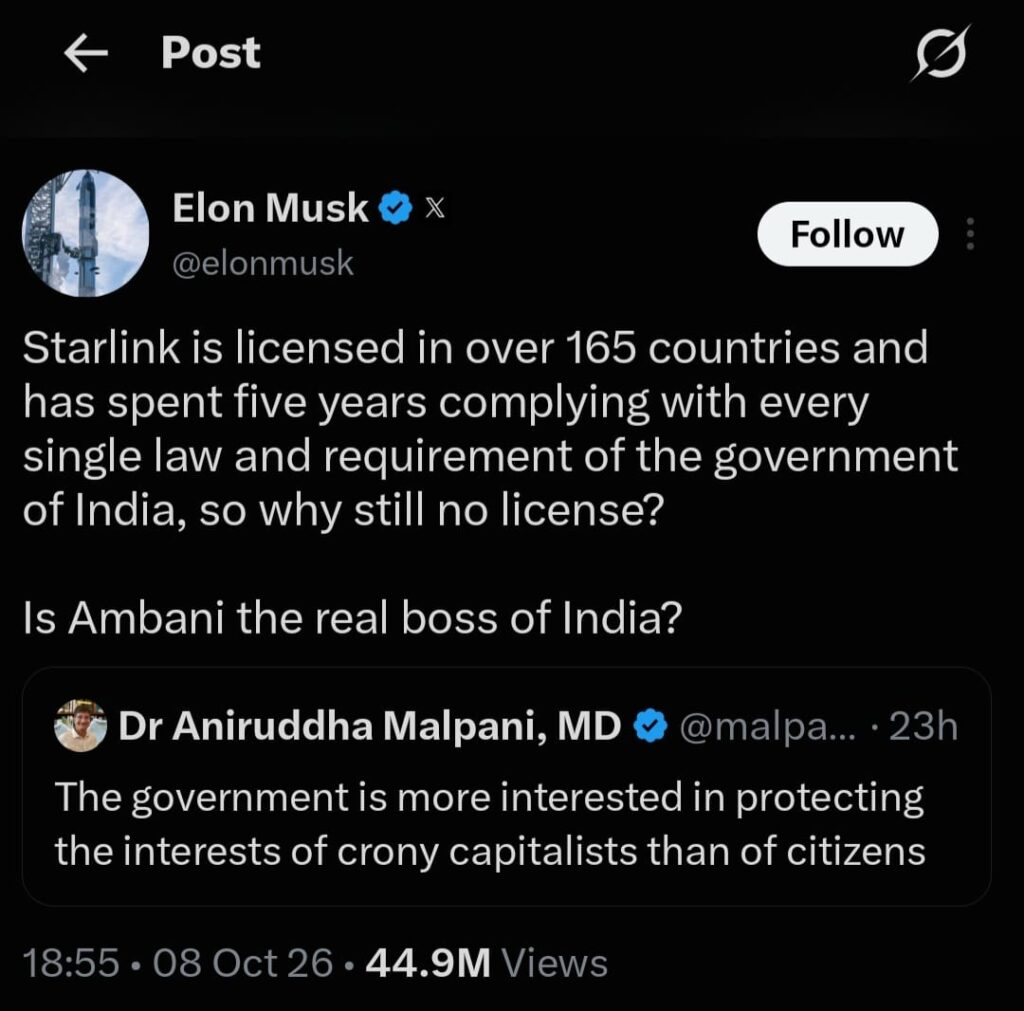
The reference was clearly to Reliance Industries chairman Mukesh Ambani, whose telecom company Reliance Jio is India’s largest mobile operator and is also involved in the satellite communications market.
This was an extraordinary escalation.
International business leaders frequently criticise regulations, licensing delays or taxation. It is much less common for the chief executive of a major global technology company seeking regulatory approval to publicly question whether one of the country’s most powerful businessmen effectively controls government decision-making.
Musk provided no evidence demonstrating that Ambani had personally caused Starlink’s regulatory delays. Reuters specifically noted that Musk had offered no evidence for the allegation against Ambani.
Reliance Jio had not publicly responded to Reuters’ request for comment on Musk’s accusation at the time of its October 9 report.
Rahul Gandhi enters the conversation
Rahul Gandhi then joined the controversy.
Responding to Musk’s question about Ambani, Gandhi wrote:
“Welcome to India, Elon. Wait till you discover the other guy.”
Gandhi did not name the “other guy.”
However, his remark was widely interpreted as an apparent reference to Gautam Adani, another major Indian industrialist whom Gandhi and the Congress party have repeatedly accused of benefiting from proximity to the Narendra Modi government.
Musk responded directly to Gandhi:
“Thank you, Rahul. This is indeed troubling.”
That brief exchange became politically explosive because it appeared to bring Musk’s allegations about corporate influence into contact with one of Rahul Gandhi’s longest-running political arguments.
Gandhi has repeatedly accused the Modi government of favouring a small group of large corporate houses. The government and the BJP have consistently rejected such allegations.
Musk’s comments therefore provided Gandhi with an opportunity to connect an international entrepreneur’s complaint with his own domestic political narrative.
Did Elon Musk actually “support” Rahul Gandhi?
This point requires caution.
Musk’s response can reasonably be described as agreeing with, or expressing concern about, the specific issue Gandhi raised in that exchange.
It should not automatically be interpreted as a broader political endorsement of Rahul Gandhi, the Congress party or Gandhi’s political agenda.
There is no evidence in the exchange that Musk endorsed Gandhi for office, supported Congress electorally or adopted Gandhi’s wider political positions.
The factual sequence is narrower:
Musk alleged that powerful commercial interests were obstructing Starlink.
Gandhi suggested that Musk would discover additional politically influential business figures.
Musk thanked him and said the situation was troubling.
That is politically significant, but it is not equivalent to a formal political endorsement.
India’s government strongly rejects Musk’s allegation
The Indian government responded directly to the claim that Starlink was being treated unfairly.
On October 8, the Ministry of Communications issued an official statement declaring that India’s regulatory framework for satellite communications was “fair and non-discriminatory.”
The ministry said three companies had received licences for non-geostationary satellite communication services and that all licensees had to demonstrate compliance with security conditions.
According to the government, security assessments were underway for all three licensed entities and they were at broadly the same regulatory stage.
The ministry therefore described suggestions that the system was discriminatory as “baseless and misconceived.”
This is an important counterpoint to Musk’s allegations.
Starlink has not simply been denied a satellite telecommunications licence.
Government records show that Starlink has already obtained GMPCS authorisation. The unresolved issues involve security compliance, spectrum assignment and subsequent operational requirements.
That makes Musk’s phrase “why still no license?” somewhat imprecise in the current context. The dispute now concerns the remaining approvals required for commercial operations rather than the complete absence of any telecom authorisation.
Why India is cautious about satellite communications
Satellite internet is not regulated like an ordinary consumer application.
A system such as Starlink uses a large constellation of low-Earth-orbit satellites to provide internet connections directly to user terminals.
That makes it particularly valuable in remote areas where laying fibre or constructing mobile towers is difficult.
But the same architecture also raises important security questions.
Governments typically want clarity over areas including lawful interception, user identification, location of gateways, network control, data handling and the ability of authorities to respond during national-security emergencies.
India’s government says these security requirements apply to all satellite communication companies, not just Starlink.
Communications Minister Jyotiraditya Scindia reiterated on October 9 that satellite operators must satisfy the required security conditions before beginning operations.
The government therefore presents the issue as a regulatory and security process rather than an effort to protect domestic telecom companies.
Musk’s commercial argument
Musk’s argument is fundamentally different.
He portrays Starlink as a disruptive competitor capable of expanding broadband access, particularly in areas where traditional telecom infrastructure is weak.
Satellite internet can indeed be particularly useful in rural, mountainous, disaster-affected and geographically isolated regions.
Starlink’s business model avoids much of the physical infrastructure required by terrestrial networks because communication occurs through a constellation of satellites connected to ground terminals.
Musk has argued that blocking or delaying such technology harms consumers who either lack internet access or face limited competition.
This gives the dispute a broader policy dimension.
The question is no longer merely whether Starlink receives final regulatory clearance.
It is also about whether India’s telecom market should welcome satellite broadband as an aggressive new competitor to established terrestrial operators.
Why Mukesh Ambani matters to the debate
Reliance Jio dramatically transformed India’s telecom market after its commercial launch in 2016.
Aggressive pricing and massive investment helped accelerate mobile broadband adoption across the country and contributed to consolidation in the telecom sector.
Today Jio is one of India’s dominant telecommunications companies.
Reliance is also interested in satellite connectivity through Jio Satellite Communications.
Starlink and Jio therefore represent potential competitors in India’s emerging satellite broadband market.
However, there is an interesting complication.
Starlink has previously reached commercial distribution arrangements with major Indian telecom companies, including Reliance Jio and Bharti Airtel, illustrating that the relationship between Musk’s company and India’s telecom incumbents has involved both competition and potential cooperation.
The dispute therefore cannot easily be reduced to a simple Starlink-versus-Jio confrontation.
The spectrum question
Another major issue has been how satellite spectrum should be assigned.
Traditional mobile telecom operators historically acquire spectrum through expensive auctions.
Satellite companies have generally argued that satellite spectrum should instead be administratively allocated because the same frequencies can be shared by multiple satellite networks.
The Telecommunications Act 2023 provided for administrative allocation of certain satellite spectrum rather than traditional auction-based allocation.
This issue previously generated disagreement between Musk and Indian telecom interests.
Musk had publicly supported administrative allocation, while Reliance had raised concerns about ensuring a level competitive environment between satellite and terrestrial broadband services.
The current confrontation therefore follows an existing history of disagreement between Musk and India’s telecom establishment.
Rahul Gandhi sees a political opening
For Rahul Gandhi, the controversy intersects directly with one of his principal political themes: the relationship between government and large corporate groups.
For years, Gandhi has repeatedly accused the Modi government of concentrating economic power and favouring selected businessmen.
The government and companies targeted by such allegations have rejected claims of improper favouritism.
Musk’s comments provided Gandhi with a high-profile external voice making a separate but related allegation about Indian corporate influence.
His reply therefore attempted to connect Musk’s Starlink complaint with his larger political criticism.
That explains why his short comment attracted disproportionate political attention.
BJP attacks Rahul Gandhi’s intervention
The BJP quickly criticised Gandhi for entering the dispute.
BJP vice-president Ram Madhav accused Gandhi of effectively championing Musk’s cause and argued that spectrum allocation in India would take place transparently and without discrimination.
The BJP’s counterargument is politically significant.
From its perspective, Gandhi appeared to be supporting the allegations of a foreign billionaire against India’s regulatory system before the country’s security procedures had been completed.
That allowed BJP leaders to reposition the controversy from one about corporate influence to one involving sovereignty, regulatory independence and national security.
The political battle consequently developed along two competing narratives.
Congress figures could frame the dispute as evidence of excessive corporate influence.
BJP figures could frame it as a foreign businessman demanding preferential treatment while India’s opposition amplifies his accusations.
Neither interpretation by itself establishes what actually caused Starlink’s regulatory delays.
Musk’s confrontational communication style
The episode also reflects Musk’s unconventional approach to corporate diplomacy.
Most multinational corporations confronted with regulatory delays rely on lobbying, formal negotiations, industry associations and private government engagement.
Musk often uses his enormous social-media reach instead.
That strategy has appeared repeatedly in disputes involving governments, regulators, advertisers and companies.
It can create immediate public pressure.
But in a heavily regulated industry such as telecommunications, it also carries risks.
A satellite communications company requires long-term cooperation with governments on spectrum allocation, national security, interception requirements, ground infrastructure and data compliance.
Publicly suggesting that a country’s policymaking is controlled by an oligarch can therefore complicate regulatory relationships even while mobilising public opinion.
Why Starlink matters strategically to India
India represents one of the world’s largest potential broadband markets.
The country already has more than a billion telecom users, but internet quality and infrastructure remain uneven across different regions.
Satellite broadband could be especially useful in Himalayan regions, islands, remote villages, border areas and locations where terrestrial infrastructure is economically difficult to deploy.
Starlink therefore represents both an economic opportunity and a regulatory challenge.
Greater competition could improve connectivity.
But satellite communications also have strategic consequences because the infrastructure providing communications can exist partially outside the physical territory of the country.
The debate therefore involves competing public interests:
faster deployment,
greater competition,
rural connectivity,
consumer affordability,
data sovereignty,
national security,
and regulatory control.
Balancing these objectives is more complicated than simply approving or rejecting one company.
The national-security dimension cannot be ignored
Satellite communications have acquired much greater strategic importance following recent conflicts around the world.
Starlink’s role in Ukraine demonstrated that privately operated satellite networks can become critical infrastructure during wartime.
That experience illustrated the enormous utility of satellite communications.
It also raised questions about the influence private companies can exercise when their networks become strategically important.
For India, which faces complex security challenges along its borders and within the wider Indo-Pacific region, communications infrastructure has obvious national-security implications.
That helps explain why the government insists that satellite operators demonstrate compliance with security conditions before commercial launch.
Competition versus protectionism
The central economic question is whether India’s regulatory system is protecting consumers or protecting incumbent companies.
Musk argues the latter.
The Indian government says the former.
At present, publicly available evidence does not establish that Reliance or another Indian corporate group caused the delay.
The government’s official position is that Starlink, Jio Satcom and Eutelsat OneWeb are undergoing comparable regulatory processes.
Musk has challenged that explanation but has not publicly produced evidence demonstrating political interference by Ambani.
This distinction matters.
Allegations concerning market influence deserve scrutiny, particularly in sectors with high barriers to entry.
But regulatory delay alone does not prove corporate interference.
What the controversy reveals about modern corporate power
Perhaps the most interesting part of the episode is that it involves several different forms of power operating simultaneously.
Musk represents global technological and financial power.
Ambani represents enormous domestic corporate and telecommunications influence.
Rahul Gandhi represents institutional opposition political power.
The Modi government controls the regulatory and national-security framework governing market access.
Social media then allows all these actors to bypass conventional institutional communication and address millions of people directly.
A dispute that might once have occurred inside government offices and corporate boardrooms is now being conducted publicly in real time.
That fundamentally changes corporate diplomacy.
Starlink could still become a major player in India
Despite the confrontation, Starlink’s long-term commercial prospects in India should be distinguished from the political argument.
The company already holds the relevant GMPCS authorisation.
The remaining path involves security compliance and spectrum assignment.
India’s government has explicitly stated that once a licensed entity completes its security assessment, it may proceed to the spectrum-assignment stage.
This suggests that the door to Starlink remains open.
The disagreement therefore concerns timing, regulatory conditions and Musk’s allegation about why the process has taken so long—not an official policy barring Starlink from India.
A controversy bigger than one company
The Musk-Starlink dispute is ultimately about much more than internet satellites.
It touches on several questions that will increasingly confront India as it becomes one of the world’s largest digital markets.
How should India regulate powerful foreign technology companies?
How should policymakers encourage competition without weakening security requirements?
How much influence should dominant domestic corporations have over technology policy?
How transparent should regulatory decisions be?
And how should political leaders respond when global business figures publicly challenge Indian institutions?
These questions will recur in artificial intelligence, cloud computing, semiconductor manufacturing, digital payments, telecommunications and space technology.
Conclusion
Elon Musk’s confrontation with India over Starlink has moved rapidly from a regulatory disagreement into a political controversy involving some of the country’s most powerful personalities.
Musk alleges that entrenched business interests are obstructing Starlink.
The Indian government rejects that accusation and says all satellite operators face the same security and regulatory requirements.
Rahul Gandhi entered the debate by connecting Musk’s complaint with his longstanding criticism of corporate influence in Indian politics.
Musk’s response—thanking Gandhi and describing the situation as troubling—created the appearance of political alignment on this particular issue.
But describing it as broad “support for Rahul Gandhi” goes further than the available evidence.
What can be said with confidence is that Musk and Gandhi briefly found common ground over allegations concerning corporate influence and Starlink’s delayed commercial launch.
Whether that exchange becomes a lasting political relationship is unknown.
The more immediate question is whether Starlink completes India’s remaining security and spectrum requirements and finally begins commercial operations.
If it does, the current argument may eventually look like an unusually public chapter in a difficult market-entry negotiation.
If the dispute continues, however, it could become a much larger confrontation over competition, sovereignty and the balance of power between governments, domestic conglomerates and global technology billionaires.
