

The recent sighting of a full-scale Advanced Medium Combat Aircraft (AMCA) engineering model at a Defence Research and Development Organisation (DRDO) radar cross-section (RCS) testing facility has generated significant interest within India’s aerospace and defence community.
The development is being viewed as an important indicator that India’s ambitious fifth-generation fighter programme has entered a critical phase of stealth validation—one of the most challenging aspects of modern combat aircraft design.
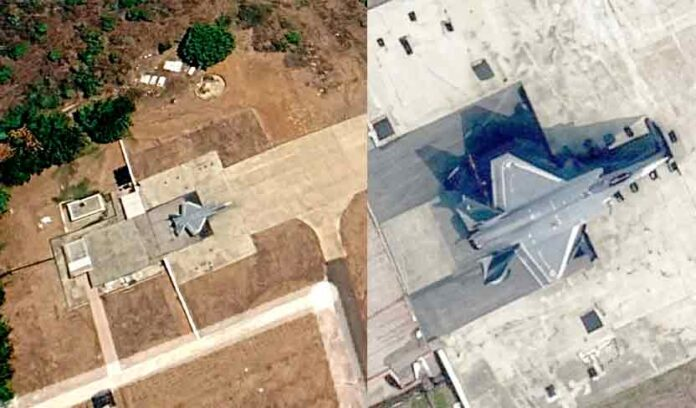
While the Aeronautical Development Agency (ADA) and DRDO have not officially commented on the specific tests being conducted, the presence of the AMCA model at a dedicated RCS measurement range strongly suggests that engineers are evaluating how effectively the aircraft can evade radar detection, a defining characteristic of any fifth-generation stealth fighter.
Why Radar Cross-Section Testing Matters
Stealth technology is often misunderstood as making an aircraft “invisible.” In reality, stealth design seeks to reduce an aircraft’s radar cross-section—the amount of radar energy reflected back toward enemy sensors. The lower the RCS, the more difficult it becomes for hostile radars to detect, track, and engage the aircraft.
RCS testing allows engineers to measure how radar waves interact with every part of the aircraft, including:
- Nose contours
- Air intakes
- Canopy structure
- Wing and tail surfaces
- Weapons bay doors
- Engine exhaust areas
Even small design imperfections can significantly increase radar visibility. As a result, stealth aircraft undergo extensive testing before prototypes ever take flight.
For the AMCA programme, successful RCS validation is essential because stealth is one of the aircraft’s core design requirements. The fighter is intended to operate in heavily defended airspace against advanced air defence systems and modern fighters equipped with sophisticated radar technologies.
The Significance of the Engineering Model
The model reportedly observed at the test facility appears to be the same full-scale engineering demonstrator showcased during Aero India 2025. That model represented the most mature public representation of the AMCA design and was manufactured using advanced composite structures by Hyderabad-based VEM Technologies.
Engineering models are not merely exhibition pieces. They are frequently used to:
- Validate stealth shaping concepts
- Assess electromagnetic signatures
- Test maintenance accessibility
- Verify manufacturing tolerances
- Evaluate sensor and weapons integration layouts
By moving the engineering model to an RCS range, DRDO and ADA can obtain real-world measurements rather than relying solely on computer simulations. Such testing enables engineers to identify radar “hot spots” and make design refinements before prototype construction advances further.
AMCA’s Stealth Design Features
The AMCA has been designed from the outset as a stealth-oriented platform. Several visible features indicate a strong emphasis on signature reduction:
Internal Weapons Bays
Unlike conventional fighters that carry missiles and bombs externally, the AMCA is designed to store weapons inside dedicated internal bays during stealth missions. External weapons significantly increase radar signatures, making internal carriage essential for low observability.
Serpentine Air Intakes
The aircraft employs curved intake ducts designed to conceal the engine compressor faces from radar exposure. Engine blades are among the strongest radar reflectors on a fighter aircraft, making intake design a critical stealth consideration.
Diverterless Supersonic Intakes (DSI)
The AMCA incorporates diverterless supersonic inlet technology, which reduces radar reflections while simplifying aircraft structure and maintenance requirements.
Radar-Absorbent Materials
The programme is expected to make extensive use of radar-absorbent materials and coatings to reduce reflected radar energy across multiple frequency bands.
Edge Alignment and Airframe Shaping
Stealth aircraft rely heavily on geometric shaping. The AMCA’s blended fuselage, canted twin tails, and carefully aligned surfaces are intended to scatter radar waves away from enemy receivers rather than reflecting them directly back.
Why This Testing Phase Is Particularly Important
Many defence analysts consider stealth validation to be among the most difficult challenges in fighter development. Aerodynamics, structural requirements, internal fuel volume, weapons integration, and stealth often compete against one another during aircraft design.
A fighter may perform exceptionally well in simulations, yet still reveal unexpected radar reflections during physical testing. This is why advanced aerospace programmes in the United States, China, and Europe invest heavily in dedicated RCS measurement facilities and repeated testing cycles.
The AMCA’s appearance at a testing range therefore suggests that the programme has moved beyond theoretical stealth design and is entering a practical validation stage where real measurements guide final refinements.
Strategic Implications for India
The AMCA is India’s first indigenous attempt to develop a true fifth-generation stealth fighter. The aircraft is expected to provide capabilities such as:
- Low-observable penetration missions
- Air superiority operations
- Deep strike capability
- Electronic warfare
- Network-centric combat operations
- Advanced sensor fusion and AI-assisted systems
These capabilities are intended to counter increasingly sophisticated regional threats, including advanced radar networks and modern combat aircraft operating in the Indo-Pacific region.
Maintaining a low radar signature is therefore not merely a technological achievement—it is central to the aircraft’s operational relevance and survivability.
What Comes Next?
The AMCA programme is currently progressing through detailed design, validation, and prototype development phases. Recent reports indicate continued work on wind-tunnel testing, structural validation, and radar signature assessment alongside prototype manufacturing activities.
If the current RCS testing campaign proves successful, engineers could lock in key aspects of the aircraft’s stealth configuration before prototype flight testing begins. Such a milestone would significantly reduce technical risks later in the development cycle.
Conclusion
The reported sighting of the AMCA engineering model at DRDO’s radar cross-section testing facility represents far more than a routine development activity. It indicates that India’s flagship stealth fighter programme is undergoing one of the most critical evaluations in modern aerospace engineering—the verification of its ability to evade radar detection.
For a nation seeking to join the small group of countries capable of designing and producing indigenous stealth combat aircraft, successful RCS testing will be a decisive step. While many challenges remain before the AMCA enters operational service, the move suggests that India is steadily advancing from conceptual stealth design toward real-world validation of its next-generation fighter.
